

The Energy of Pyramids
A physicist spent a decade visiting the most ancient and mysterious structures on Earth — armed with a calibrated sensor, a scientific question, and no predetermined conclusions. Here is what the data shows.
For centuries, people have described a feeling at the pyramids — something they couldn't explain, something that drew them back. A physicist decided to stop guessing and start measuring. What he found was consistent, repeatable, and quietly extraordinary.
There is a pattern that cuts across every culture and every era of human civilization: people build pyramids. The Egyptians. The Maya. The Aztecs. The Bosnians. Separated by oceans, millennia, and entirely different cosmologies, these civilizations all converged on the same geometry — a broad base rising to a point. And not just the shape: they built their most sacred structures this way, investing resources that seem almost impossible by modern standards.
The official explanations involve religion, royalty, and astronomy. But for decades, a parallel inquiry has grown among physicists, engineers, and archaeologists: what if the shape itself does something? What if the convergent triangular geometry interacts with electromagnetic fields, seismic vibrations, or atmospheric ionization in ways that ancient builders discovered empirically — and that modern instruments can now detect?
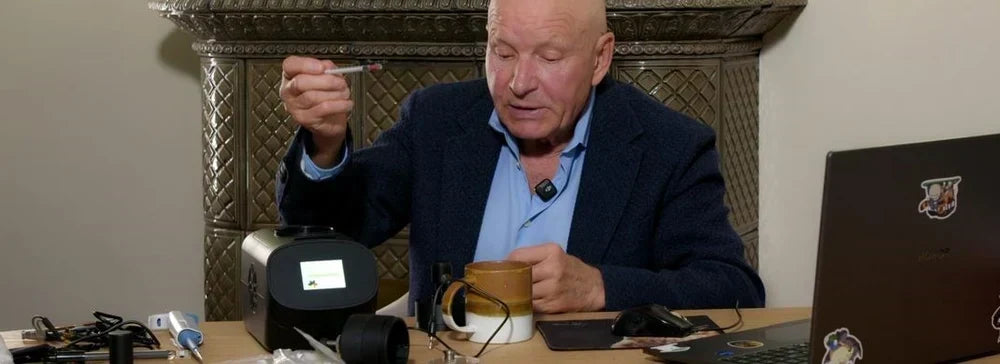
Prof. Korotkov's approach was refreshingly direct: take a calibrated instrument to the sites themselves, establish a local baseline, place the sensor at the pyramids, and record the numbers. No theory required. Let the data lead.
🔬 The Instrument: Bio-Well's Sputnik Sensor
The Sputnik sensor is Bio-Well's environmental electrophotonic imaging device — a calibrated instrument that measures the photon and electron emission of the local environment, outputting a numerical energy value in Joules (×10⁻² J). Unlike subjective reports or dowsing rods, it produces numbers you can compare, chart, and replicate.
The sensor applies a brief high-voltage, high-frequency electric field to the surrounding air, stimulating photon emission from local molecules — a controlled gas-discharge process analogous to the Kirlian effect, but precisely calibrated for scientific measurement.
Rather than visual impressions, the Sputnik outputs a numerical energy value in Joules. Each session records 20 consecutive frames, from which mean energy and statistical variation are calculated — enabling rigorous comparison between locations.
Before every field session, Korotkov calibrated the sensor at a neutral baseline location — typically the hotel room or a location removed from the sites. This establishes a reference accounting for local climate, altitude, humidity, and temperature.
Modern hotel construction uses standardized materials with no special geometry or orientation. They represent the ambient electromagnetic and photonic background of a region without architectural amplification — making them a reliable local zero-point reference for comparison.
All comparisons in this research are within-region. Egypt readings are compared to the Cairo hotel — never to readings from Mexico. This controls for altitude, humidity, temperature, and local geomagnetic variation as confounds. The finding is always directionally consistent: pyramid and ancient temple sites produce higher readings than local hotel baselines.
🌍 Where He Went: A Decade of Field Research
Between 2012 and 2024, Korotkov and collaborators visited pyramid and ancient temple sites across four continents. Each site was approached with the same protocol: calibrate locally, measure at multiple points, record everything.
Teotihuacan — Where the Gods Were Born
At its height, Teotihuacan was one of the largest cities in the ancient world — home to over 125,000 people, contemporary with the height of ancient Rome, and then abandoned without obvious cause. When the Aztecs arrived centuries later, they found only the empty pyramids and named the place "where gods were born." Modern archaeology still debates what happened here. The Sputnik sensor found something worth recording.
Readings were taken at the summit of each pyramid on both visits — 2012 and 2019, seven years apart. All three pyramids registered energy values significantly higher than the nearby hotel, with the temporal replication adding important weight: the same site, the same instrument protocol, seven years later, the same result. That is not a random fluctuation.
During the 2019 visit, Korotkov was invited into tunnels recently discovered beneath the pyramids by leading Mexican archaeologist Sergio Gomez. The visceral experience was immediate: "we felt depressed — wanting to get out into the sunshine as soon as possible." The sensor confirmed the subjective experience with data. Tunnel readings were among the lowest in the entire multi-year study. The pyramids above pulled energy up. The passages beneath pulled it down. Same physical site, opposite readings depending on where you stood.
Monte Albán and the Altitude Question
Sitting at 1,940 meters above sea level and 400 meters above the surrounding Oaxaca valley, Monte Albán's readings were among the highest in the entire Mexican dataset. This raises a legitimate methodological question: does altitude itself elevate readings, through reduced atmospheric density, higher cosmic ray flux, or ionization differences? Korotkov addresses this directly — his comparison is always the Monte Albán readings vs the Oaxaca hotel at the same altitude, not vs sea-level sites. Within-region comparison controls for altitude. Even altitude-adjusted, the ancient site outperforms its local baseline.
The Caana Pyramid and the Vertical Gradient
Belize's Mayan pyramids receive a fraction of the tourism of their Mexican counterparts — and because of that, you can still climb them freely. The Caana pyramid at Caracol rises 43 meters, making it still one of the tallest man-made structures in the country. What made the Belize measurements particularly instructive was the discovery of a clear vertical gradient: readings differed not just between hotel and pyramid, but between the base and the summit of the same structure.
The vertical gradient is a key finding. It means the pyramid isn't merely near something with high energy — the pyramid itself appears to be doing something to the local energy field, with the effect increasing toward the apex. The measurement at the summit is higher than at mid-level, which is higher than at the base, which is still higher than the hotel. This is the signature of a concentrating effect, not a coincidental co-location.
The ATM Cave is one of the most significant sacred sites in the Maya world — an underground network where human sacrifice rituals were performed between 700 and 900 AD, and where crystallized skeletal remains are still visible on the cave floor today. Archaeologists describe it as priceless. The Sputnik recorded 1.63 J at the cave entrance, dropping further to 1.12 J after just five minutes inside. These are among the lowest absolute values in the entire study. Places associated with ancient death and sacrifice consistently returned the lowest readings. Pyramid summits returned the highest. Whether this reflects something about the physical structure, the material, the geometry, or something else entirely — the pattern is unmistakable.
The Bosnian Pyramids: The Anomaly That Inverts Everything
In the early 2000s, Bosnian-American archaeologist Dr. Sam Osmanagich proposed that the distinctive triangular hills near Visoko — long assumed to be natural formations — were in fact ancient pyramids. Excavations revealed massive slabs of man-made origin on their slopes. The discovery generated years of scientific controversy. Korotkov visited multiple times, taking measurements at the pyramids and in the extensive tunnel network running beneath them. The data from Bosnia is the most surprising in the entire study.
Mexico's tunnels produced the lowest readings of any site visited. Bosnia's tunnels produced readings above the local hotel baseline. Both are underground passages beneath ancient pyramid structures. What separates them? The Bosnian tunnels were filled with earth approximately 2,000 years ago (analysis confirms this timeframe), and unlike the Mexican tunnels — which were constructed for unclear purposes — the Bosnian tunnels have generated hundreds of documented testimonials from visitors reporting health improvements and increased wellbeing after spending time inside. Korotkov's instrument is picking up something real. The question of what exactly is the open scientific frontier.
Egypt: The Hardest Campaign — and the Most Revealing
Egypt was the most logistically challenging campaign of the entire decade-long study. The Egyptian government forbids unauthorized instruments near the monuments, maintains constant surveillance, and prohibits meditation or ceremonies at the sites. Korotkov and American collaborator Nima Farshid adapted: using Bio-Well Mini with a smartphone (small enough to avoid detection) and "one finger" measurement mode to record 20 consecutive frames wherever they could find corners away from guards. Despite these constraints, the data they collected is entirely consistent with every other site in the study.
The Granite Factor: Why Aswan Stood Apart
The highest readings in the entire Egypt campaign weren't at the Great Pyramid or the Sphinx. They were in Aswan — spread broadly across the region, not concentrated at any single structure. The explanation may be geological. Aswan sits on an enormous deposit of pink granite with unusually high silica content. This same granite was the material the ancient Egyptians chose for their most significant constructions — obelisks, sarcophagi, the inner chambers of the most important pyramids. They transported it hundreds of kilometers north to Giza and Saqqara at extraordinary cost.
Silicon dioxide — the primary component of quartz and a major constituent of Aswan granite — is piezoelectric: it generates an electrical charge under mechanical pressure and vibrates in response to electromagnetic fields. Large masses of high-silica granite subject to constant low-level seismic vibration (which is present in all geological environments) could generate measurable local electromagnetic anomalies. The ancient Egyptians may have selected Aswan granite not purely for its appearance, but because generations of empirical experience had shown them it had special properties — properties that a modern Sputnik sensor can now begin to quantify.
⚡ The Serapeum: When the Instrument Went Silent
Of all the sites Korotkov visited in a decade of field research, one produced the most anomalous result — not a high reading, not a low reading, but no reading at all.
The Serapeum at Saqqara is an underground corridor over 500 meters long, 3 meters wide, and 5 meters high. It contains 24 massive granite boxes. Each box weighs 55–70 tons. Each lid weighs 20–30 tons. The boxes were all sealed. They were all empty. No mummies. No grave goods. No evidence of looting. The polished interior surfaces of some boxes are machined to tolerances of fractions of a millimeter — a precision that raises serious questions about what tools were available to the builders. The corridor was buried in sand until French archaeologist Auguste Mariette discovered it by chance in 1850. Archaeological consensus calls it a tomb complex. The construction details — the scale, the precision, the emptiness, the sealed-and-empty granite containers — have led a significant number of researchers to propose that it was an engineering installation of some kind.
Inside the Serapeum, the Sputnik's Bluetooth connection was completely severed. No measurement was possible. What makes this remarkable is that the same phenomenon simultaneously affected the video camera, which was recording audio via Bluetooth. Both electronic devices lost Bluetooth connectivity in the same corridor at the same time — and both recovered when removed from the space. This is not a failed battery or a software glitch. It is a documented, cross-device electromagnetic anomaly in a specific underground location. The 55–70 ton granite boxes, their lids, and the corridor's granite walls — all high-silica stone, all machined to unusual precision — may be generating or interacting with electromagnetic fields in ways that selectively block radio-frequency transmission. This is not mysticism. It is an engineering question that currently has no accepted answer. The Serapeum may be the most interesting unresolved anomaly in Korotkov's entire study.
📊 The Complete Picture: All Sites Compared
| Site | Country | Position | Reading vs Local Baseline | Notable Detail |
|---|---|---|---|---|
| Pyramid of the Sun | Mexico | Summit | ↑ Significantly Above Replicated ×2 | Same result 2012 and 2019 |
| Pyramid of the Moon | Mexico | Summit | ↑ Above baseline | All 3 Teotihuacan pyramids elevated |
| Teotihuacan Tunnels | Mexico | Underground | ▼ Very low Low | "Wanted to get out immediately" |
| Chichen Itza — Kukulkan | Mexico | Summit | ↑ Above | Two independent readings |
| Monte Albán complex | Mexico | 1,940m altitude | ↑ High (altitude-adjusted) | Compared to same-altitude Oaxaca hotel |
| Caracol — Caana Summit | Belize | Summit 43m | ↑ Peak for region | Highest reading at highest point |
| Caracol Ruler's Tomb | Belize | 5m below summit | ↑ High | Underground, yet elevated — contrasts ATM Cave |
| Actun Tunichil Muknal | Belize | Sacred cave | ▼ 1.63 → 1.12 J (dropping) Lowest | Reading fell during 5-min measurement |
| Bosnia — Sun Pyramid | Bosnia | Summit | ↑ Above hotel | Both foot and summit elevated |
| Bosnia — Tunnels | Bosnia | Underground | ↑ Above hotel Inverts Mexico | Opposite of Mexican tunnel pattern |
| Giza Sphinx | Egypt | Ground level | ↑ Above Cairo hotel | 6am private access, covert measurement |
| Red Pyramid — Interior | Egypt | Interior chamber | ↑ Peak for Saqqara | Corbelled chamber, 15m ceiling |
| Aswan — Isis Temple | Egypt | Pink granite zone | ↑ Highest in Egypt | High-silica granite; elevation not site-specific |
| Serapeum, Saqqara | Egypt | Underground corridor | — Unmeasurable Signal Block | Bluetooth blocked both Bio-Well and video camera |
🧠 Three Scientific Frameworks for What's Being Measured
Korotkov is a physicist, not a mystic. His published interpretation of these results is explicitly multi-causal and acknowledges that no single mechanism accounts for all the data. Here are the three most scientifically grounded frameworks:
The pyramid's converging triangular geometry may act as a passive antenna — focusing and concentrating ambient electromagnetic field lines toward the apex. Computer modeling of electromagnetic fields shows that conical and pyramidal forms concentrate field density at their tip. This could directly explain the consistent summit > base > hotel gradient observed across multiple sites and multiple structures.
Quartz-bearing granite — especially the high-silica Aswan variety used throughout Egyptian monumental construction — is strongly piezoelectric: it converts mechanical pressure into electrical charge. Large stone masses subject to constant low-level seismic vibration generate measurable local electromagnetic fields. The Sputnik sensor detects photon and electron emission, which would be elevated wherever piezoelectric activity is present in the surrounding geology.
Archaeological analysis across multiple cultures shows a striking pattern: the most significant ancient structures are consistently sited on or near geomagnetic anomalies — locations where the Earth's field is locally stronger or more variable. Whether ancient builders detected these locations through dowsing, sustained phenomenological observation, or methods we haven't reconstructed, the co-occurrence of high-energy readings and ancient monumental sites is consistent across every culture in this study.
No single framework accounts for all the data. The Bosnia tunnel inversion (high energy underground, opposite of Mexico) remains unexplained by geometry alone. The Serapeum signal block is unexplained by any current mainstream model. Korotkov's conclusion in the papers is explicit: these findings warrant systematic multi-instrument investigation under controlled conditions. The data is reproducible. The mechanism is an open question.
📐 The Pyramid Energy Gradient: A Visual Model
One of the most reproducible findings in this study is the vertical gradient: summit readings consistently exceed mid-level readings, which consistently exceed base readings, which consistently exceed the hotel baseline nearby. The pyramid structure itself appears to concentrate or amplify the local energy field toward its apex.
🌎 What This Actually Means
These findings live at an intersection that makes mainstream scientists uncomfortable and spiritually inclined people excited — which is, historically, exactly where genuinely novel research tends to appear first. The easy mistake is to over-claim in either direction: to dismiss the data because you don't want pyramid energy to be real, or to leap to ancient cosmic power stations because you do.
What the data actually shows is more interesting than either extreme:
1. Ancient structures produce measurable energy anomalies. Calibrated modern instruments detect consistent, statistically significant differences between ancient monument sites and modern hotel baselines — across four continents, over a decade of measurements.
2. The pattern is temporally reproducible. Sites measured in 2012 returned the same directional results in 2019. Reproducibility is the cornerstone of scientific validity.
3. Underground spaces are not uniformly depressed. Bosnia tunnels (high), Caracol tomb (high), Mexican tunnels (very low), Serapeum (signal block) — all behave differently. The builders' material and geometric choices appear to encode different energetic properties, and a calibrated sensor can detect the differences between them.
4. The measurement tool is sensitive enough to detect what is actually there. Bio-Well's Sputnik captured extraordinary elevations at Aswan, extraordinary suppressions at ATM Cave, and something entirely outside its expected operating range at the Serapeum. It is doing its job.
There is a deeper implication for how we think about ancient knowledge. The builders of Giza, Teotihuacan, and the Bosnian pyramids didn't have electromagnetic spectrometers. But they had thousands of years of empirical observation — generations of people noticing how they felt in different structures, in different materials, at different heights. What Korotkov is now quantifying with modern instrumentation may simply be the scientific confirmation of what ancient builders discovered through their own kind of measurement: direct, sustained, multi-generational human experience with the built environment.
The pyramids were not built by accident. They were built by people who paid extraordinary attention to what their world was doing — and responded with precision and effort that still staggers the imagination. That attention deserves our own.


Share:
GDV Research Review 2008–2023 | Bio-Well Scientific Literature Summary
How Do You Measure Energy in the Human Body? A Science-Based Guide to Every Method