
A technical deep-dive into gas discharge visualization: what Bio-Well actually measures versus what those measurements indicate
The Question Every Practitioner Should Be Able to Answer
When a client asks "What is Bio-Well actually measuring?" — what do you say?
The answer matters. It's the difference between positioning yourself as a credible professional using validated technology versus someone who can't explain their own tools.
This article gives you the physics. Not simplified to the point of inaccuracy, but clear enough to explain confidently.
The Critical Distinction
MECHANISM (What it measures)
Photon emissions from stimulated electron discharge at the fingertips
INTERPRETATION (What it indicates)
Correlations to organ systems, stress states, and energetic balance based on empirical research
Understanding this distinction lets you speak accurately about the technology while still communicating its practical value to clients.
The Physics: What Actually Happens During a Scan
Bio-Well technology is based on Gas Discharge Visualization (GDV), a technique with roots in Kirlian photography but refined through decades of scientific development. Here's the process broken down:
The Four-Stage Scanning Process
Electromagnetic Stimulation
A brief, high-intensity electromagnetic pulse (10 kV at 1024 Hz, microampere current) is applied to the glass plate beneath the fingertip.
Electron Extraction
The electromagnetic field extracts electrons from the skin surface. These electrons collide with air molecules surrounding the fingertip.
Gas Ionization & Photon Emission
Electron collisions ionize air molecules, creating a cascade effect. As excited electrons return to ground state, they emit photons — visible light in the 480-800nm wavelength range.
Digital Capture & Analysis
A CCD camera beneath the glass captures the photon emissions. Software analyzes the glow pattern's area, intensity, and geometric characteristics.
This is pure physics. The device applies an electromagnetic field, electrons are extracted, gas ionizes, photons emit, camera captures. No interpretation required at this stage — just measurable phenomena.
The Quantum Biophysics: Why Photon Emissions Reflect Physiology
Here's where it gets interesting. The photon emissions aren't random — they vary systematically based on the physiological state of the person being scanned. Why?
The scientific literature points to a quantum biophysical model:
"The main reservoir of free energy in biological processes is electron excited states of the complex molecular system. This quantum model supports an argument that EPI techniques provide indirect judgment about the level of energy reservoir at the molecular level in structure protein complexes."
— Electro Photonic Analysis in Medicine, GDV Bio-Electrography Research
In simpler terms: your cells are constantly engaged in electron transport — it's fundamental to metabolism, energy production, and cellular signaling. The electrons extracted during a Bio-Well scan reflect this underlying electron activity.
The Electron-Photon Connection
Delocalized π-electrons in protein macromolecules provide an energy reservoir for physiological processes.
Specific structural protein complexes within the skin provide channels of heightened electron conductivity.
Stimulated emissions from the skin are developed mainly by transport of these delocalized electrons.
This is why the photon emissions vary: they're reflecting the electron activity in your tissues, which in turn reflects metabolic and energetic states.
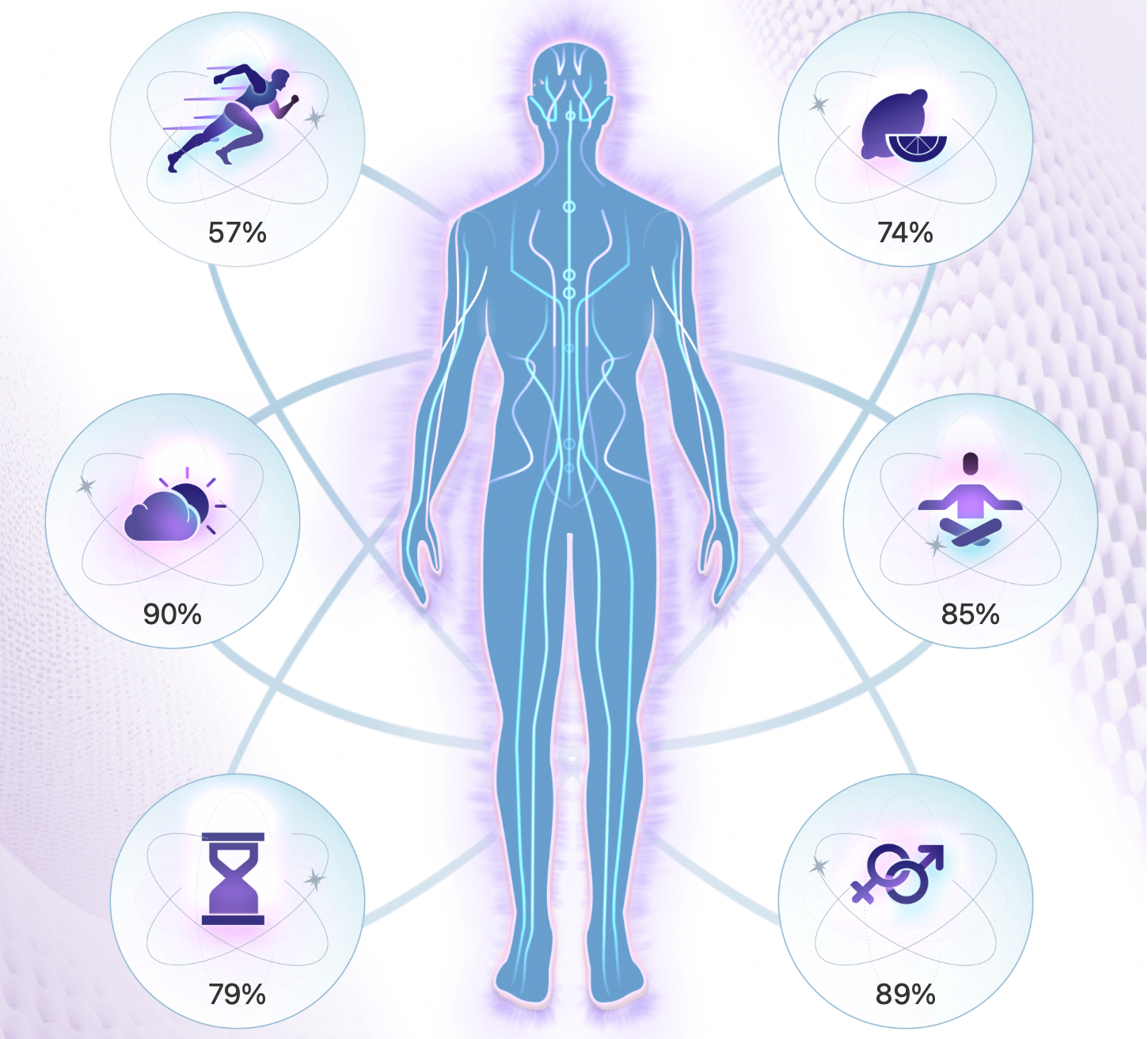
From Fingertips to Organs: The Meridian Connection
Now we move from mechanism to interpretation. This is where Bio-Well bridges physics and practical application.
The fingertip emissions are divided into sectors, with each sector corresponding to different organ systems. This mapping didn't appear arbitrarily — it emerged from two sources:
Traditional Chinese Medicine
Dr. Peter Mandel in Germany developed the initial diagnostic map based on acupuncture meridian theory — the same system the WHO formally recognized in their International Classification of Diseases (2022).
Empirical Clinical Data
Dr. Korotkov and teams at Russian medical institutions refined the mapping through clinical trials — comparing EPI patterns against diagnosed conditions across thousands of subjects over decades.
The result is a diagnostic map that's been validated both theoretically (meridian science) and empirically (clinical correlation studies). Research shows healthy individuals' EPI readings vary only 8-10% over many years — indicating high measurement precision.
The Parameters: What Bio-Well Software Actually Calculates
When you run a scan, the software doesn't output vague impressions. It calculates specific, quantifiable parameters:
| Parameter | What It Measures | Unit |
|---|---|---|
| Energy | Intensity of photon emissions × area | Joules |
| Stress Index | Curvature analysis of emission contour | Calculated units |
| Form Coefficient | Contour length² ÷ area (complexity of pattern) | Ratio |
| Entropy Coefficient | Outer contour ÷ inner contour (regulatory chaos) | Ratio |
| Left-Right Balance | Symmetry between bilateral emissions | Percentage |
| Area | Total pixels in emission pattern | Pixel count |
These aren't subjective assessments — they're mathematical calculations performed on measurable optical data. The "Energy" parameter, for instance, is literally calculated in Joules using a formula that multiplies emission area, intensity, and a correction factor.
The Validation: Clinical Research Correlations
The critical question: do these calculated parameters actually correlate with physiological states?
Multiple peer-reviewed studies demonstrate they do:
HRV Correlation Study (Estee Lauder / New Venture Technologies)
GDV stress index and entropy parameters correlated significantly with heart rate variability — the gold standard for autonomic nervous system assessment. When sympathetic activation increased, corresponding GDV parameters shifted measurably.
Coronary Heart Disease Study (Ukrainian Medical Academy)
126 cardiac patients showed statistically significant differences in energy parameters compared to healthy controls. Lateralization syndrome (left-right asymmetry) appeared in 21-24% of cardiac patients, correlating with autonomic dysfunction.
Bronchial Asthma Study (St. Petersburg Medical University)
247 asthma patients showed characteristic GDV patterns that could track disease progression and treatment response. The same research team developed clinical protocols for using GDV in patient monitoring.
Speaking Accurately: How to Explain Bio-Well to Clients
With this understanding, you can now explain the technology accurately:
✓ Accurate Explanations
"Bio-Well captures the photon emissions from your fingertips when stimulated by an electromagnetic field. These emissions reflect the electron activity in your tissues."
"The software analyzes the pattern and calculates parameters like energy level in Joules and stress indicators. These have been correlated in clinical research with physiological states."
"The organ mapping is based on meridian theory validated by WHO and refined through decades of empirical clinical trials at medical institutions."
✗ Claims to Avoid
"Bio-Well photographs your aura" — It captures photon emissions from gas discharge, not a metaphysical energy field.
"This diagnoses health conditions" — It provides correlative data that complements other assessment methods.
"The energy field around your body" — The glow is from ionized gas, not a pre-existing field being made visible.
The Bottom Line: Measurement vs. Meaning
Bio-Well measures something real and quantifiable: photon emissions from stimulated electron discharge. This is physics.
What those measurements indicate about organ systems, stress states, and energetic balance comes from decades of empirical correlation research. This is validated interpretation.
When you understand both layers, you can use the technology with confidence and explain it accurately — positioning yourself as a knowledgeable professional rather than someone making claims they can't support.
The technology is grounded in physics.
The interpretations are grounded in research.
That's a foundation you can build a credible practice on.
Technical References:
Korotkov, K.G. (2002). Human Energy Field Study with GDV Bioelectrography. Backbone Publishing.
Cioca, G.H., Giacomoni, P., Rein, G. (2004). A Correlation Between GDV and Heart Rate Variability Measures. Measuring Energy Fields: Current Research.
Alexandrova, R. et al. (2004). Analysis of the Bioelectrograms of Bronchial Asthma Patients. Measuring Energy Fields: Current Research.
Korotkov, K.G. (2014). Energy Fields: Electrophotonic Analysis in Humans and Nature.
Kushwah, K.K. et al. (2016). Development of normative data of electro-photonic imaging technique for a healthy population in India. International Journal of Yoga.


Share:
Electrophotonic Imaging in Clinical Settings: From Cardiology to Stress Assessment
The WHO Recognition of Meridian Points: What It Means for Modern Practitioners