
The Study at a Glance
Peer-reviewed · Open access on PubMed Central
Journal
J Evidence-Based Complementary & Alternative Medicine
Authors
Bhat RK, Deo G, Mavathur R, Srinivasan TM
Institution
S-VYASA University, Bangalore, India
Sample
102 participants across 3 groups
In This Guide
Why This Study Matters
Here's the question the researchers were asking: If you scan someone's fingertips with a GDV device, can the patterns in the data tell you anything about their blood sugar levels?
This matters because fasting blood sugar (FBS) testing currently requires a blood draw — needles, lab processing, waiting for results. If fingertip emission patterns correlate reliably with blood sugar levels, it could open the door to a completely non-invasive screening method. Not a replacement for blood tests, but a potential early-warning system.
The Central Question
Can the light emitted from your fingertips — captured by a GDV device — correlate with what a blood test reveals about your sugar metabolism?
What the Researchers Did
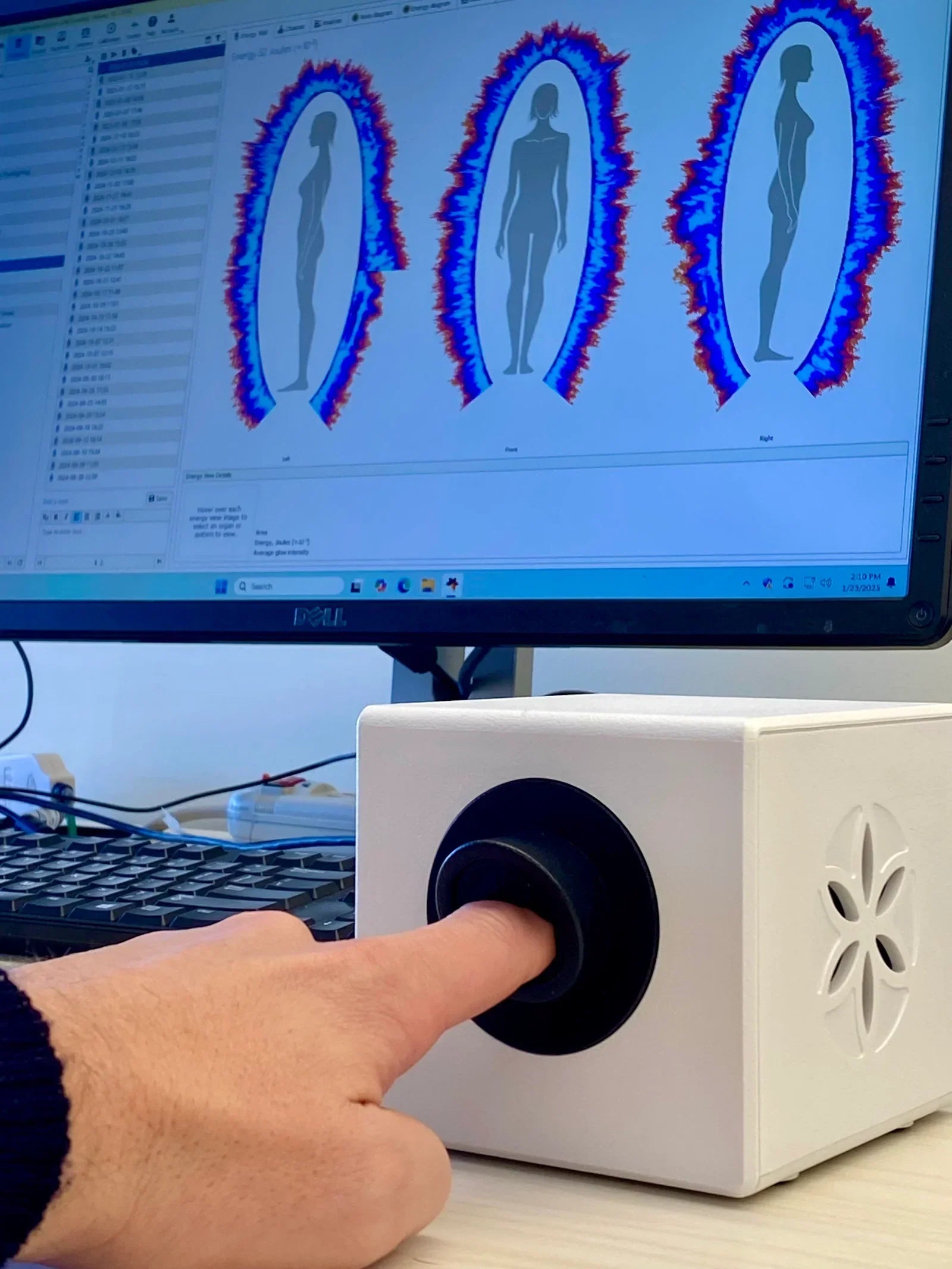
The team at S-VYASA University in Bangalore screened 200 people from yoga camps and the university's health center. Of those, 102 qualified for the study (the rest had incomplete data or image quality issues). Each person got both a standard fasting blood sugar test and a full EPI (GDV) fingertip scan.
Study Design
29
Normal
FBS < 100 mg/dL
13
Prediabetic
FBS 100–125 mg/dL
60
Diabetic
FBS ≥ 126 mg/dL
Each participant received a standard 10-finger EPI scan. The researchers then used regression analysis to look for correlations between EPI parameters (area, intensity, entropy, organ-specific readings) and fasting blood sugar levels. They analyzed each group separately — because, as it turned out, the correlations were different depending on whether you were healthy, prediabetic, or diabetic.
Interactive: The Key Findings
Tap each group to see what the researchers found when they compared fingertip emission patterns to blood sugar levels:
Select a group above to see what the EPI scan revealed about their blood sugar patterns.
The Surprise: Why Patterns Differed by Group
Perhaps the most interesting finding wasn't that the EPI data correlated with blood sugar — it was that the correlations were different depending on the stage of the disease.
Think about what this means: the fingertip emission patterns didn't just show "high sugar" or "low sugar." They showed a progression — from generalized patterns in healthy people, to organ-specific patterns in prediabetics, to multi-system disruption in diabetics. This mirrors exactly how diabetes actually develops in the body.
NORMAL
Systemic shift
Whole-body energy
PREDIABETIC
Organ-specific
Pancreas + right kidney
DIABETIC
Multi-organ
Immune + kidney + systemic
The Second Bangalore Study
The same research group at S-VYASA published a companion study in 2016 — this time with 200 subjects from a diabetic center in Bangalore. Rather than looking for correlations, this study went a step further: they used a neural network classifier to try to predict diabetes status from EPI data alone.
Kumar et al., 2016
This study collected EPI data from all 10 fingers and then analyzed the meridian sectors, chakra readings, and organ parameters specifically associated with diabetes. They used machine learning (IBM SPSS neural network) to attempt classification of participants into diabetic and non-diabetic categories from EPI data.
Together, these two studies from the same university and timeframe provide independent data points suggesting that EPI/GDV parameters contain information relevant to metabolic health. The combination of correlation analysis and machine learning classification strengthens the overall finding.
What the Study Can't Tell Us
This is a genuinely interesting study — but like all single studies, it has important limitations that must be stated clearly:
Small sample size
102 total participants, with only 13 in the prediabetic group. The prediabetic finding — arguably the most interesting one — rests on a very small sample. Larger studies with hundreds of prediabetics would be needed to confirm.
Single institution
All participants came from yoga camps in Bangalore, India. The sample may not represent the general population. Multi-center studies across different populations would strengthen the findings.
Correlation ≠ diagnosis
The study found correlations between EPI parameters and blood sugar. Correlation is not the same as diagnostic accuracy. The study does not claim that EPI can diagnose diabetes — only that the parameters are related.
Cross-sectional design
This was a snapshot in time. Longitudinal studies tracking the same individuals as they progress from normal → prediabetic → diabetic would provide much stronger evidence about whether EPI can detect early changes.
What This Means for Bio-Well Users
This study doesn't mean Bio-Well can diagnose diabetes. It means that GDV/EPI technology captures data that has a statistically significant relationship with a major metabolic marker. That's a meaningful finding that supports the broader premise of Bio-Well: that fingertip emission patterns contain physiologically relevant information.
For practitioners, the takeaway is that the organ-sector readings in your Bio-Well reports — especially pancreas and kidney zones — may be capturing real physiological signals, not just noise. This supports using Bio-Well as a complementary screening tool alongside conventional lab work, rather than as a replacement for it.
Read the full study yourself
The complete paper is freely available on PubMed Central.
Sources Cited in This Article
- Bhat RK, Deo G, Mavathur R, Srinivasan TM. "Correlation of Electrophotonic Imaging Parameters With Fasting Blood Sugar in Normal, Prediabetic, and Diabetic Study Participants." J Evidence-Based Complementary & Alternative Medicine. 2016;22(3):441-448. PMC5871158 → · PMID: 27821611 →
- Kumar SK, Srinivasan TM, Nagendra HR, Marimuthu P. "Electrophotonic Imaging Based Analysis of Diabetes." Int J Complement Alt Med. 2016;4(5):134-137. DOI: 10.15406/ijcam.2016.04.00134 →
- Korotkov, K. "Review of EPI papers 2008–2018." Int J Complement Alt Med. 2018;11(6). DOI →
- IUMAB GDV research database — diabetes studies index. iumab.org →
- Bio-Well technology overview. bio-well.com/pages/science →


Share:
Bio-Well reviews: what 5,000+ practitioners actually say
Bio-Well scan price: what to expect and what's included