

For most of its history, structured water research had a credibility problem — not with the findings, but with the measurement. How do you prove that water has changed when it looks, tastes, and chemically tests as identical to what it was before?
The biological effects were real and reproducible. The difficulty was showing, in real time, in minutes, with a number rather than a petri dish, that a given sample of water had actually been meaningfully altered. Without that, every study had to wait days for germination data or weeks for animal outcomes. The gap between treating water and proving it was treated remained wide.
The 2026 paper by Nefedov, Grabova, Lindinger, and Korotkov closes that gap. And it does it using Bio-Well Element — a device most people associate with environmental energy measurement, not analytical water science.
That reframing is worth understanding in full.
What Bio-Well Element Actually Does to a Drop of Water
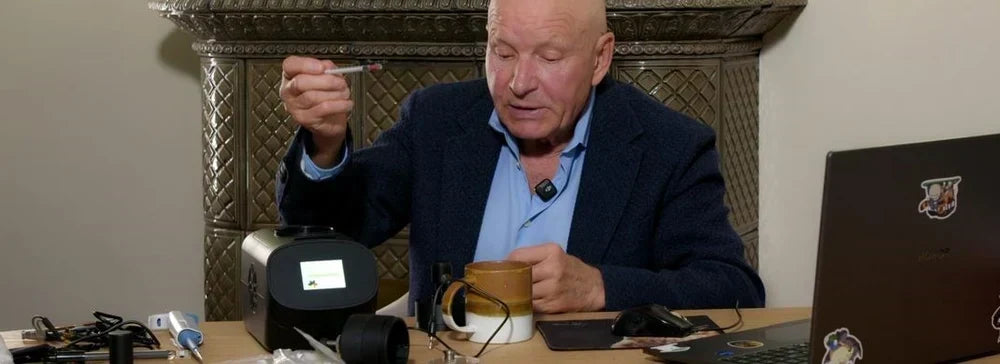
Place a drop of water on the Bio-Well Element electrode. A controlled pulse of electromagnetic energy is applied. The water responds — emitting a corona discharge, a brief biophotonic glow stimulated by that pulse. A specialized CCD camera captures the glow at high resolution. Software analyzes the resulting image across more than 20 quantifiable parameters.
The shape, size, symmetry, and energetic character of that discharge pattern is not random. It reflects the molecular organization of the water itself. Different organizational states — different hydrogen bond networks, different degrees of coherence in the molecular structure — produce measurably different photonic outputs. The same way different crystal structures diffract light differently. The water is revealing its internal architecture through the way it glows.
The Measurement Process
The process takes minutes. There is no chemical analysis. There is no waiting. You have a quantified result that characterizes the water's structural state — comparable across samples, reproducible within sessions, and sensitive enough to detect differences that carry measurable biological consequences.
What the Study Used It to Prove
The researchers ran 50 Bio-Well Element measurements on control water and 50 on magnetically treated water. Not 5. Not 10. 50 each — enough to establish statistical confidence that goes well beyond coincidence.
Every key parameter showed statistically significant differences. But there was a secondary finding in the data that deserves its own moment: the treated water didn't just score differently — it scored more consistently.
This is precisely what the coherent domain hypothesis predicts. If magnetic treatment is organizing water molecules into more stable, coherent configurations — systems that behave together rather than independently — you'd expect not just different average values but reduced scatter around those values. The data shows exactly that.
Why This Matters Beyond This One Study
The researchers make an important claim in their discussion section — one that extends the significance of this work well beyond the specific magnetic treatment system they tested:
From the Paper
"The Bio-Well method can be used as a first-line test for water samples treated with a magnetic field or another method. The process of recording and processing the results takes just a few minutes, making it a rapid analysis method."
— Nefedov et al. J Appl Biotechnol Bioeng. 2026
Or another method. That's the key phrase. They're not saying Bio-Well Element is useful only for evaluating magnetic water treatment. They're saying it's a general-purpose rapid assessment tool for the structural state of liquid samples — regardless of how that state was altered or what altered it.
Think about what that opens up. Any intervention that works through water — supplements dissolved in water, structured water systems, environmental influences on water quality, even the effects of human intention on water samples (a research area with its own published literature) — can now be evaluated with a measurement that takes minutes and returns quantifiable, comparable data.
🔬 Research Applications
Rapid first-line screening for any water treatment study. Replace days of germination data with minutes of discharge measurement as a preliminary verification step.
🌿 Wellness Practice
Compare water sources, structured water devices, or preparation methods. Quantify differences between samples that standard chemistry would call identical.
🧪 Product Development
Any product that interacts with or is dissolved in water — supplements, homeopathics, agricultural inputs — can be assessed for structural influence on the aqueous carrier.
🏡 Environmental Monitoring
Track changes in local water quality, seasonal variation in water structure, or the influence of electromagnetic environments on water before and after mitigation.
The Machine Learning Layer
One detail in the paper points toward where this technology is heading. Alongside the standard Bio-Well Element analysis, the researchers reference a separately published methodology for using machine learning to classify gas discharge images of liquid solutions — developed by Korotkov and Sychev in 2025.
This matters because human visual classification of discharge patterns — even with quantified parameters — has limits. Machine learning doesn't. As a training dataset of water discharge images grows — spanning different treatment methods, different water sources, different biological conditions — an AI classification system can begin distinguishing patterns that no human analyst would catch and no conventional test would detect.
Where This Is Going
The combination of Bio-Well Element's optical measurement with AI classification creates something genuinely new: a system that can characterize the structural state of water with increasing precision as the model learns. The 2026 paper is a foundation stone. The multicentre study the researchers plan next will expand that foundation considerably.
What Three Posts Have Been Building Toward
We opened this series with a finding that shouldn't be possible — water acquiring properties from neighboring water with no physical contact, confirmed across two independent experimental systems. We followed it with the biological data: seeds, yeast, bloodworms, all responding to a change in water that chemical analysis couldn't see.
This final post has been about the instrument that made it visible. Bio-Well Element didn't just validate the treatment — it provided the measurement framework that turned a biological observation into a scientific result. Without a rapid, quantifiable, reproducible measurement of the water's state, every biological experiment remains a demonstration rather than a proof. Bio-Well Element provides the proof.
The broader implication is this: water is not inert. It has states. Those states are measurable. They affect living biology in ways that are statistically significant and directionally consistent across multiple species and experimental designs. And we now have an instrument fast enough, sensitive enough, and sophisticated enough to detect those states without waiting for the plants to grow.
Changed the nature of water. That's the conclusion of a peer-reviewed study published in 2026, using a measurement instrument that reports results in minutes. The science isn't settled — the researchers themselves are careful to call this preliminary and are planning larger trials. But the signal is clear, it's reproducible, and the tools to study it rigorously now exist.
What comes next will be interesting to watch.
Research reference: Nefedov VI, Grabova IA, Lindinger MI, Korotkov KG. Evaluation of the effect of water treated with a magnetic field on the selected technical and biological systems. J Appl Biotechnol Bioeng. 2026;13(1):29–33. DOI: 10.15406/jabb.2026.13.00414. Funding disclosed: Defiance Brands, Inc., Nashville, TN, USA. This article is for educational purposes only and does not constitute medical advice.


Share:
What Happened When We Gave Seeds Magnetized Water
What a Scan Showed Before and After 24 Days